Scaling Human Teams: A Practical Guide to Overcoming Communication Bottlenecks
Overview
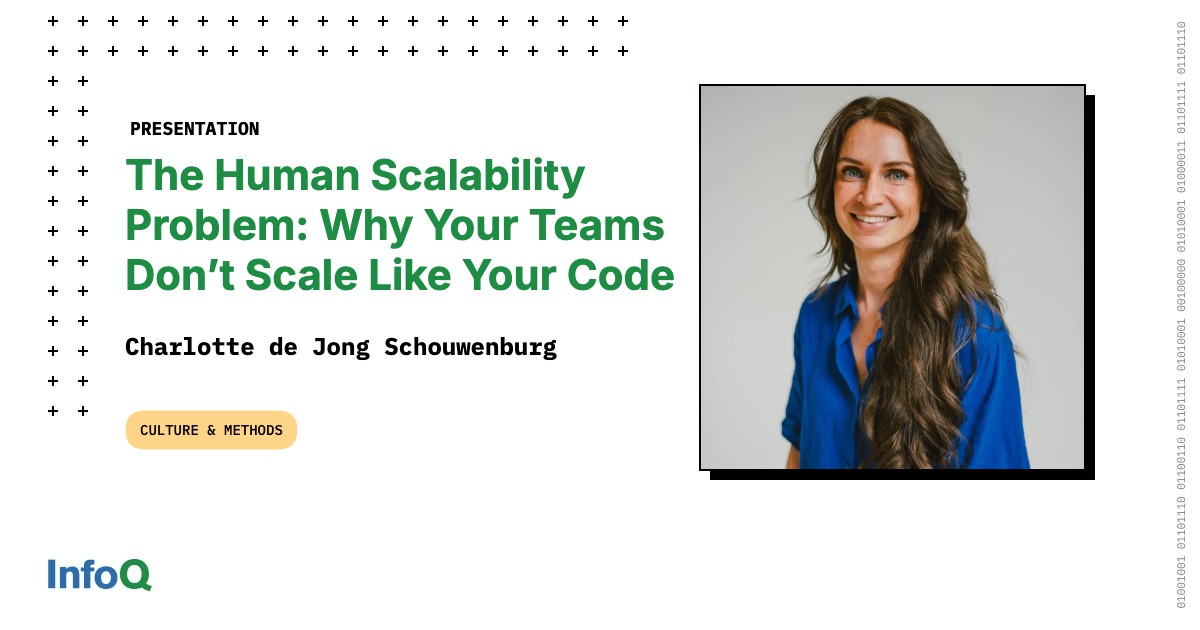
In the fast-paced world of technology, we are accustomed to scaling code: we add servers, optimize databases, and deploy microservices. But when it comes to scaling people, the rules change. Charlotte de Jong Schouwenburg's insights into behavioral scalability reveal a painful truth: while our systems scale effortlessly, human cooperation often breaks down under hyper-growth. This tutorial transforms her key concepts into a step-by-step guide for leaders who want to maintain high-performing, autonomous teams without sacrificing speed or culture. You'll learn how to diagnose communication overload, design a communication architecture, and "engineer trust" within your organization.

Prerequisites
Before diving into the guide, ensure you have the following foundations in place:
- Team leadership experience – You are currently managing or coaching at least one team (5-15 people) and have authority to implement structural changes.
- Basic understanding of agile methodologies – Familiarity with Scrum, Kanban, or similar frameworks helps, but is not required.
- Access to communication tools – Your organization uses at least one synchronous (e.g., Slack, Teams) and one asynchronous (e.g., email, wiki) platform.
- Willingness to experiment – You are open to trying new meeting formats, documentation standards, and feedback mechanisms.
Step-by-Step Instructions
Step 1: Assess the Human Bottleneck
Before you can fix communication overload, you must measure it. Use the following diagnostic checklist to identify where context is lost:
- Count the number of daily meetings per team member (target: ≤3).
- Track message volume – How many Slack messages per person per day? (Target: ≤50 for deep work roles.)
- Survey context loss – Ask: “On a scale of 1-10, how often do you feel uninformed about decisions made in other teams?”
- Measure decision latency – How long does it take to get a yes/no on a cross-team question? (Target: <24 hours for async.)
Create a simple spreadsheet with these metrics for each team. This baseline will guide your interventions.
Step 2: Design a Communication Architecture
Just as software has architecture (API layers, data flow), human communication needs structure. Follow these sub-steps:
A) Define Channel Purpose
Assign strict roles to every communication channel:
- Slack channel #team-alpha – Only for urgent, time-sensitive issues (response expected within 15 minutes).
- Slack channel #team-alpha-updates – Asynchronous daily status updates (response within 4 hours).
- Email – For formal decisions, agreements, and documentation (response within 24 hours).
- Weekly all-hands – 30-minute sync with recorded agenda; no deep diving.
Document these rules in a shared wiki page titled Communication Charter.
B) Implement Async-First Rule
Adopt a default to asynchronous communication for non-urgent matters. For example:
- Use shared documents with comments instead of real-time meetings for brainstorming.
- Replace stand-up meetings with a daily text update in a dedicated channel.
- Record presentations so team members can watch on their own schedule.
This reduces constant interruptions and preserves deep work time.
C) Structure Cross-Team Interactions
Create a liaison model: each team appoints one person who participates in a weekly cross-team coordination meeting. All other members are free from cross-team noise. The liaison then summarizes relevant updates for their team in a 5-minute async post.
Step 3: Engineer Trust
Trust is not a soft skill; it can be built through deliberate systems. Here are proven tactics:
- Transparency by default – Share all project boards, OKRs, and meeting notes with the entire organization (no need-to-know restrictions).
- Decision logs – For every significant decision, write a short (1-2 paragraph) log with the rationale, alternatives considered, and final outcome. Host in a shared repository.
- Feedback schedules – Implement weekly 1:1s and monthly 360-degree reviews using a structured template (e.g., “Start, Stop, Continue”).
- Psychological safety checks – Regularly survey how safe team members feel to voice concerns; address low scores with private conversations.
These mechanisms create an environment where trust is not dependent on individual personality, but on consistent behavior.
Step 4: Preserve Context with Documentation
Lost context is the silent killer of scalability. Use the following documentation practices:
- Decision journals – Maintain a shared document that records decisions made in meetings, including who was present and the key trade-offs.
- Glossary of terms – Define acronyms and domain-specific jargon (e.g., “CLV – Customer Lifetime Value”) in a company wiki.
- Meeting templates – Every meeting must have an agenda (sent 24h before), a designated note-taker, and outcomes posted within 2 hours.
- Q&A repositories – When a question is answered publicly (e.g., in a Slack thread), archive it in a searchable forum like Confluence or Notion.
By making context discoverable, you reduce the cognitive load on existing team members and accelerate onboarding of new hires.
Step 5: Maintain Culture During Scaling
Culture is the sum of behaviors you reward. To keep high-performing teams intact:
- Celebrate behavioral scalability – Recognize individuals who document thoroughly, respond to async queries, and help preserve context.
- Hire for communication maturity – In interviews, include a scenario: “How do you handle receiving conflicting information from two sources?” Look for structured, collaborative responses.
- Scale rituals deliberately – When a team grows beyond 10 people, split into sub-teams (pods) of 5-7, each with its own rituals. Keep cross-pod synchronization minimal.
- Run quarterly retrospectives – Dedicate one session to “communication health” – review the metrics from Step 1 and adjust the architecture.
Common Mistakes
Avoid these pitfalls that many leaders fall into:
- Over-engineering communication – Creating too many channels or rules overwhelms people. Start with 2-3 changes and iterate.
- Neglecting the async-first transition – Simply declaring “no more meetings” without providing asynchronous alternatives leads to chaos.
- Ignoring emotional load – Trust engineering fails if leaders do not also invest in empathy and conflict resolution.
- Copying other companies’ structures – A communication architecture that works for Spotify may not work for a 50-person startup. Tailor it to your team size and culture.
- Forgetting to measure impact – Without revisiting the baseline metrics from Step 1, you won’t know if your changes are working.
Summary
Scaling human teams requires intentional design, not just hope. By assessing communication overload, architecting communication flows, engineering trust through transparency, preserving context with documentation, and nurturing culture, you can overcome the human scalability problem. Implement the steps one at a time, and your teams will grow without breaking speed or cohesion.