Exploring Reinforcement Learning Without Temporal Difference: The Divide and Conquer Method
Introduction
Reinforcement learning (RL) has achieved remarkable successes, yet many of its most popular algorithms rely on temporal difference (TD) learning. TD methods, such as Q-learning, use bootstrapping to update value estimates, which can lead to error accumulation over long horizons. This article explores an alternative paradigm—divide and conquer—that avoids TD learning altogether and scales well to complex, long-horizon tasks. We'll examine the strengths and weaknesses of both TD and Monte Carlo approaches, and show how a divide-and-conquer strategy offers a fresh path forward in off-policy RL.
Understanding Off-Policy Reinforcement Learning
In RL, algorithms are broadly categorized as on-policy or off-policy. On-policy methods, like PPO and GRPO, require fresh data collected by the current policy; old experience must be discarded after each update. Off-policy methods, in contrast, can learn from any data—past trajectories, human demonstrations, or even internet logs. This flexibility is crucial when data collection is expensive, such as in robotics, healthcare, or dialogue systems.
Off-policy RL is more general but also harder. As of 2025, we have solid recipes for scaling on-policy RL, but scaling off-policy RL to long-horizon tasks remains an open challenge. The difficulty lies in how we learn the value function.
The Challenge of Temporal Difference Learning
Temporal difference learning is the backbone of many off-policy algorithms. The classic Q-learning update uses the Bellman equation:
Q(s, a) ← r + γ maxa' Q(s', a')
This bootstrapping—using the estimate of the next state to update the current state—introduces a problem: errors in Q(s', a') propagate backward, accumulating over the entire horizon. The longer the task, the more severe the error buildup. This is why TD methods often struggle with long-horizon tasks. (For more details, see this deeper analysis.)
Why Error Accumulation Matters
Each Bellman recursion adds a layer of approximation. In a 100-step task, errors can compound exponentially, making value estimates unreliable for distant states. This is not just a theoretical issue—practitioners see it in domains like robot manipulation or strategic games.
Monte Carlo as an Alternative
To mitigate bootstrapping errors, one common fix is to mix TD with Monte Carlo (MC) returns. For instance, n-step TD learning uses the actual cumulative reward for the first n steps and then bootstraps for the remainder:
Q(st, at) ← Σi=0n-1 γi rt+i + γn maxa' Q(st+n, a')
By reducing the number of bootstrapping steps, error accumulation is less severe. In the limit n = ∞, we obtain pure Monte Carlo value learning, which uses entire episodes and avoids bootstrapping entirely.
While n-step TD works reasonably well, it is not a fundamental solution. Pure MC has its own drawbacks—it requires complete episodes, has high variance, and cannot learn from partial trajectories. The RL community has long sought a more principled alternative.
A Divide and Conquer Approach
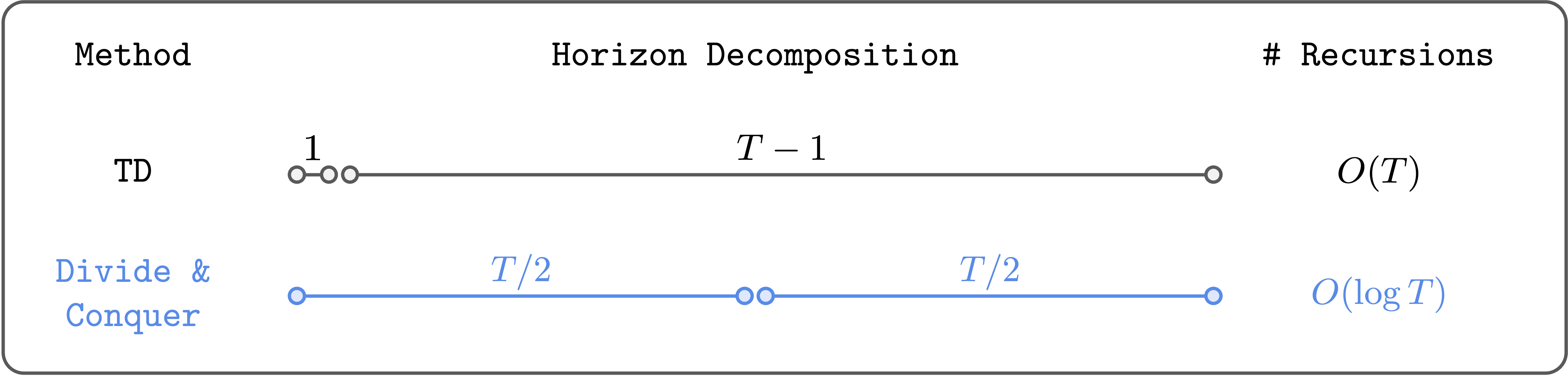
Instead of escaping TD errors by mixing with MC, a different paradigm exists: divide and conquer. The core idea is to decompose a long-horizon task into smaller subproblems, solve each independently, and then combine the solutions. This approach drastically reduces the effective horizon for any single learning step.

How It Works
Rather than learning a single value function over the entire state space, divide-and-conquer RL identifies natural subgoals or bottlenecks. Each subproblem can be solved with a short-horizon method (e.g., pure MC or a local Q-function). The global policy then selects which subgoal to pursue next, akin to hierarchical RL. Crucially, bootstrapping across subproblems is minimized—errors do not propagate beyond each subproblem's boundary.
Advantages Over TD
- Scalability: Since each subproblem has a short horizon, error accumulation is negligible.
- Sample efficiency: Off-policy data can be reused across subproblems, leveraging all available experience.
- Robustness: The method does not rely on Bellman backups, making it less sensitive to approximation errors.
Early implementations of this idea have shown promise in complex domains like robotics and game playing, where TD methods previously faltered. For example, recent studies demonstrate that divide-and-conquer RL can learn optimal policies for 1000-step tasks without the error explosion seen in Q-learning.
Research Examples
Several works in 2024–2025 have explored variants: some use learned subgoal detectors, others use demonstrations to segment tasks. A common theme is that the resulting algorithms are simple to implement and stable to train, requiring no target networks or experience replay tuning.
Conclusion
Temporal difference learning has been the workhorse of reinforcement learning for decades, but its bootstrapping nature imposes a fundamental limit on long-horizon tasks. While n-step TD and Monte Carlo returns offer partial relief, they do not address the root cause. The divide-and-conquer paradigm provides a fresh perspective, breaking long tasks into manageable pieces and avoiding error propagation entirely. As off-policy RL continues to grow in importance, this alternative may unlock scalable solutions for the most challenging real-world problems.
For further reading, see our posts on TD error accumulation and off-policy learning basics.