10 Technologies Powering Your Spotify 2025 Wrapped Experience
Every December, Spotify Wrapped transforms millions of listening histories into a personalized story. But behind the colorful graphics and shareable slides lies a complex engineering ecosystem. In 2025, Spotify has refined its tech stack to deliver even deeper insights—from genre micro-moments to emotional trends. Here are the ten key technologies that bring your Wrapped to life.
1. Machine Learning Models for Listening Patterns
Spotify uses a suite of supervised and unsupervised ML models to analyze your year-long listening behavior. These models identify patterns like favorite artists, genre shifts, and listening sessions. In 2025, transformers and sequence-to-sequence networks enable more nuanced predictions—for example, detecting when you switched from upbeat workout playlists to mellow evening sets. The models are trained on anonymized aggregated data, then fine-tuned per user, ensuring each Wrapped feels uniquely yours.
2. Real-Time Data Pipelines
To process billions of streams daily, Spotify relies on a real-time data pipeline built on Apache Kafka and Apache Flink. When you press play, that event is ingested within milliseconds. For Wrapped, these pipelines batch historical data over 12 months, reconciling partial listens, offline plays, and cross-device activity. This ensures your “Top Songs” count even that track you played three times during a road trip without cell service.
3. Audio Feature Extraction
Every track’s acoustic properties—tempo, key, loudness, danceability, energy—are extracted using deep audio analysis. In 2025, Spotify’s neural networks use contrastive learning to embed tracks into a multidimensional space. This powers Wrapped features like “Your Audio Aura” and “Mood Evolution,” mapping your listening to color palettes and emotional arcs. The extraction runs server-side via TensorFlow Serving, updated weekly as new tracks are added.
4. Personalization Ranking Algorithms
Wrapped’s “Top Artists” and “Top Genres” aren’t just raw counts. Spotify applies a weighted ranking algorithm that considers frequency, recency, and dwell time. For 2025, a reinforcement learning component adjusts weights based on user engagement—if you often skip a song, it counts less than a repeated full listen. This algorithm also prevents gaming the system, ensuring that one night of non-stop repeat doesn’t hijack your year-end list.
5. Graph Databases for Connected Experiences
Spotify uses Neo4j graph databases to map relationships between users, tracks, artists, and playlists. For Wrapped, this enables features like “Your Musical DNA” and “Collaborative Listening,” showing which friends share your taste. In 2025, graph queries run in sub‑second time even on billion‑node graphs, thanks to distributed partitioning and in-memory caching. This allows you to see how your listening connects to global trends—not just your personal bubble.
6. Privacy-First Data Anonymization
Because Wrapped relies on sensitive listening data, Spotify has a dedicated privacy layer. All raw user IDs are hashed before they enter the Wrapped pipeline. In 2025, differential privacy techniques add calibrated noise to aggregate statistics, making it impossible to reverse‑engineer individual behavior from shared Wrapped slides. The system also enforces strict access controls: only a handful of production servers see plaintext data, and logs are purged after processing.

7. Cloud Infrastructure with Auto-Scaling
Wrapped is a massive batch job that runs in November, processing petabytes of logs. Spotify uses Google Cloud Platform with Kubernetes orchestration. Compute clusters automatically scale from hundreds to tens of thousands of nodes during peak processing. For 2025, spot instances and preemptible VMs reduce cost, while a custom scheduler ensures critical jobs finish first. The result: your Wrapped is ready in under 24 hours after the cutoff date.
8. Natural Language Generation for Storytelling
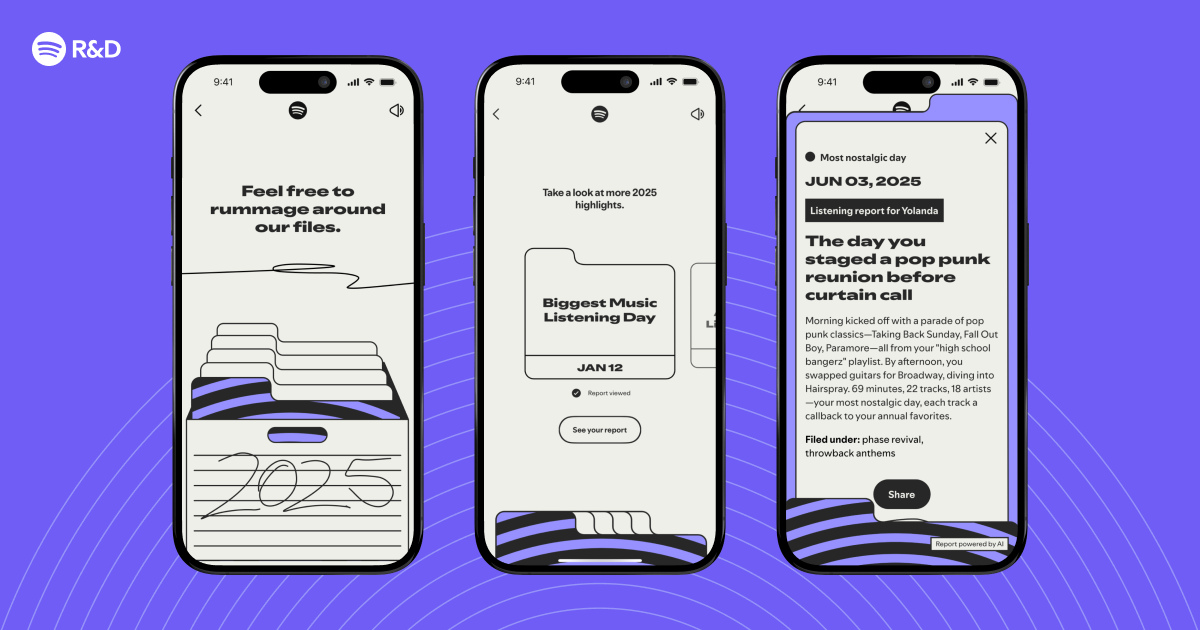
The narrated introductions in Wrapped—like “Your listening peaked in March”—are generated by NLG models. In 2025, Spotify uses GPT‑style architectures fine‑tuned on millions of user stories and curated copy. The models produce concise, varied narratives that avoid repetition across years. A reward model scores each draft for engagement and tone, then selects the best version. This gives each Wrapped a human‑like narration without manual scripting.
9. Caching and CDN for Global Delivery
When you tap “See Your Wrapped,” the personalized assets (images, videos, audio snippets) must load instantly. Spotify leverages a multi‑tier caching strategy: edge caches on Cloudflare CDN store often‑accessed templates, while user‑specific data is served from Redis clusters near regional POPs. In 2025, adaptive bitrate streaming pre‑generates micro‑videos for social sharing, encoded on the fly using FFmpeg in serverless functions. Loading times hover under 200ms worldwide.
10. Continuous A/B Testing and Experimentation
Every new Wrapped feature is tested via internal experiments. Spotify runs continuous A/B tests on interface layouts, animated transitions, and even the order of slides. In 2025, the platform uses Bayesian evaluation to quickly identify winning variants without affecting user experience. This ensures that only the most engaging and bug‑free features go live, and that your Wrapped feels fresh each year while respecting privacy and performance.
From real‑time data pipelines to NLG storytelling, Spotify’s 2025 Wrapped is a showcase of modern engineering. The next time you share your stats, remember: behind those sleek slides is a fusion of machine learning, cloud scaling, and privacy‑by‑design that makes your year in music truly memorable.