Breaking the Forking Trap: Meta's Multi-Year WebRTC Modernization Journey
Introduction
Real-time communication (RTC) is the backbone of many Meta services, from global Messenger and Instagram video chats to low-latency Cloud Gaming and immersive VR casting on Meta Quest. To meet the performance demands of billions of users, Meta spent years developing a specialized, high-performance variant of the open-source WebRTC library. However, permanently forking a large open-source project often leads to a common industry trap: initial good intentions (a quick internal optimization or bug fix) can eventually result in a divergent fork that becomes increasingly difficult and costly to merge with upstream updates. Meta recently concluded a massive multiyear migration to break this cycle, successfully moving over 50 use cases from a divergent WebRTC fork to a modular architecture built on top of the latest upstream version. This article details the engineering solutions that allowed Meta to escape the forking trap while maintaining continuous upgrades and A/B testing capabilities.
The Challenge: The Monorepo and the Static Linker
Upgrading a library like WebRTC can be risky, especially when serving billions of users across diverse devices and environments. A one-time upgrade could introduce regressions that are hard to roll back. To mitigate this, Meta prioritized A/B testing capabilities: running the legacy version of WebRTC alongside the new upstream version with clean patches, applying features in the same app, and dynamically switching users between the two to verify the new version's performance and stability.
Due to application build graph and size constraints, Meta also prioritized finding a solution to statically link two WebRTC versions. However, static linking violates the C++ linker One Definition Rule (ODR), causing thousands of symbol collisions. This forced Meta to find a way to make two versions of the same library coexist in the same address space.
The Dual-Stack Architecture Solution
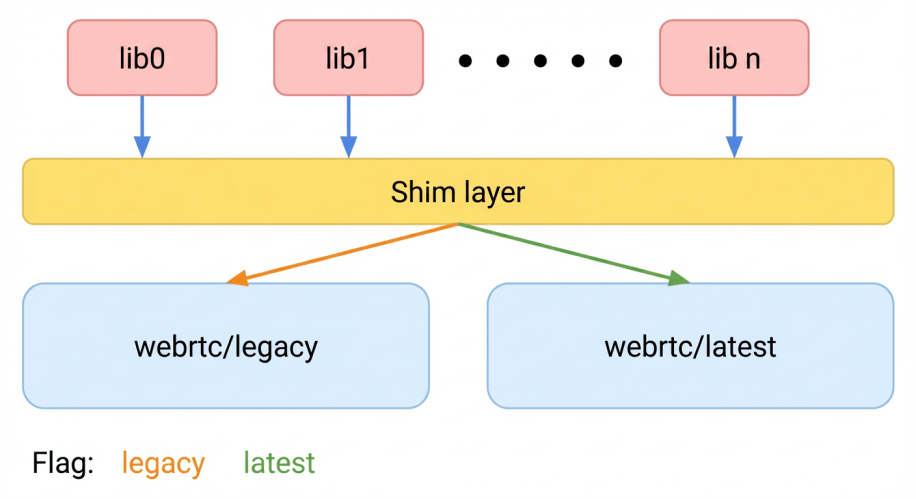
To overcome the ODR violations, Meta engineered a dual-stack architecture that allowed two versions of WebRTC to be built simultaneously within a single library. This architecture enabled safe A/B testing across more than 50 use cases by encapsulating each version behind a thin abstraction layer. The legacy version and the new upstream version could be compiled side-by-side, with symbol collisions resolved through careful namespace management and compile-time flags.
The solution involved:
- Namespace isolation: Wrapping each WebRTC version in separate namespaces to avoid ODR conflicts.
- Build system modifications: Adapting the monorepo's build graph to produce two distinct static libraries that could be linked independently.
- Runtime switching: Implementing a dynamic selection mechanism that allowed the application to switch between versions at runtime based on user assignment for A/B experiments.
A/B Testing Across 50+ Use Cases
With the dual-stack architecture in place, Meta could conduct large-scale A/B testing across all its RTC use cases, including Messenger video calls, Instagram Live, Cloud Gaming, and VR casting. Each use case could be gradually migrated to the new upstream WebRTC version while monitoring performance, binary size, and security metrics. The ability to roll back any user to the legacy version minimized risk and allowed for fine-grained experimentation.
Key benefits of this approach:
- Performance improvements: The new upstream version brought optimizations like better codec handling and reduced latency.
- Binary size reduction: Modular architecture allowed stripping out unused components, resulting in smaller app footprints.
- Security updates: Continuous upgrades meant faster patching of vulnerabilities exposed in the legacy fork.
Continuous Upgrades and Maintaining the Workflow
After the initial migration, Meta established a workflow for continuous integration of upstream WebRTC releases. Instead of performing large, risky upgrades, the team now A/B tests each new upstream release against the current version before rolling it out globally. This iterative approach ensures that performance regressions are caught early and that Meta can benefit from community improvements without the overhead of maintaining a divergent fork.
The workflow includes:
- Automated merging of upstream changes into a staging branch.
- Regression testing across 50+ use cases using the dual-stack A/B framework.
- Gradual rollout to a percentage of users, with automatic rollback if error rates spike.
Conclusion
Meta's successful escape from the forking trap demonstrates that large-scale WebRTC modernization is possible without sacrificing stability or innovation. By building a dual-stack architecture that enables safe A/B testing and continuous upgrades, Meta has transformed its RTC infrastructure into a more agile, secure, and performant system. This approach not only solved the immediate challenge but also established a sustainable model for future WebRTC upgrades, ensuring that Meta's billions of users continue to enjoy high-quality real-time communication. The lessons learned can be applied by any organization facing similar challenges with large open-source forks.